Commodity Content Is Finished.
Non-Commodity Content Is the Whole Game Now.
Google pointed at something big at a recent conference. Here is what it means, why it matters most in markets like insurance, and how to build content that an LLM has every reason to recommend.
Those of you in the SEO industry will already know the image. It is the one Google shared at a conference not too long ago, where they laid out a new type of content strategy. Commodity content on one side. Non-commodity content on the other.
Here is my view on Google:
Google lies about a lot of things. But in terms of the direction it is heading, it tends to follow through.
They will downplay a ranking factor in a tweet and then quietly build a whole update around it. So I have learned to watch what they point at, not what they say.
This is them pointing at something big. I am doubling down on the non-commodity side of that line. Here is why, and here is what it actually means in practice.
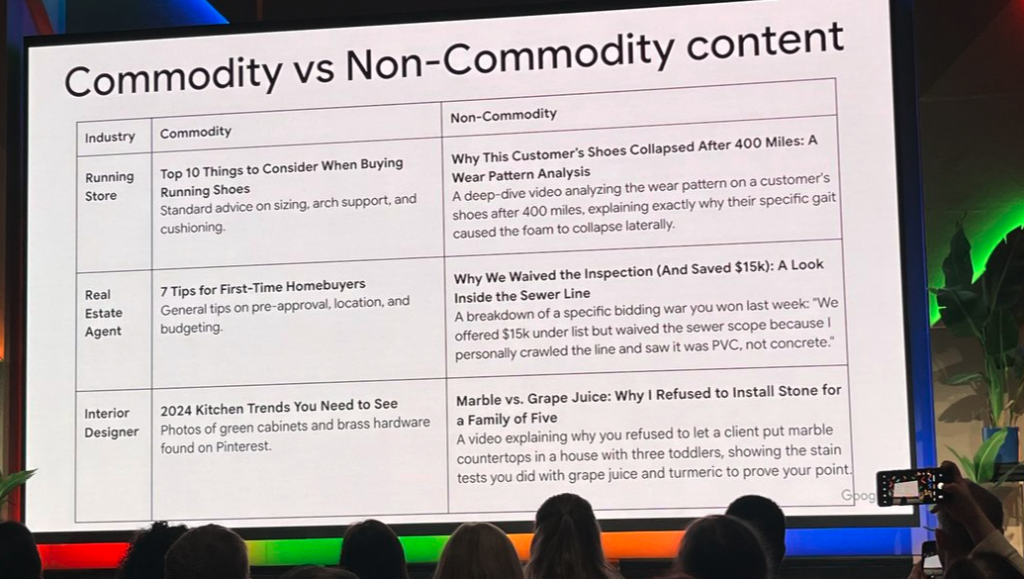
Google, slide shared at a recent conference laying out the commodity vs non-commodity content distinction. The right-hand column is what Google is asking for. The left is what most sites are still publishing.
Section 01
What commodity content actually is
The test
If your page disappeared tomorrow, would anyone actually lose anything?
For commodity content the answer is no. Another result slides into the gap and the searcher is none the wiser.
Commodity content is the stuff anyone could write. You look at what already ranks. You find the general consensus. And you go and agree with it: the same talking points, the same headings, the same generic advice sitting on a hundred other pages. Just slightly tidier.
Think about what that produces at scale. A web full of pages that all say roughly the same thing, fighting over who said it marginally better.
It worked for years because Google was matching ten blue links to a query, and "a bit better than the others" was enough to win a slot.
That is not the job any more. The thing reading your content now is trying to decide who is actually worth recommending, and "a bit better" gives it nothing to grab.
This is why so much hard-working content has quietly stopped pulling traffic. It was never bad. It was just replaceable.
Section 02
What non-commodity content is, and why Google wants it
Non-commodity content is the stuff only you can write. It is pulled from real work. First-hand experience. Original data. A point of view that someone with an internet brief simply cannot reproduce.
This is the part of E-E-A-T people skip over. Experience does not mean you researched the topic. It means you were actually there. You ran the campaign. You handled the claim. You dealt with the consequence and learned something from it.
Instead of agreeing with the consensus, you educate. You feed Google, and you feed the LLMs, something they do not already have.
"We did X to achieve Y. This is what happened. Here are the results."
That is the shape of it.
You are telling the model what you did, what you achieved, and how you are different. You are handing it information it cannot get from the forty other pages saying the obvious thing.
There is a name for this idea floating around the industry: information gain. The amount of genuinely new information your page adds on top of everything already indexed on the subject.
Commodity content has an information gain of basically zero. It restates. Non-commodity content adds. And the more it adds, the harder it is to leave you out of the answer.
Commodity content
Tries to blend in.
Agrees with the consensus. Restates what already exists. Information gain: zero. Replaceable by any other result in the SERP.
Non-commodity content
Stands out and teaches.
Adds something the model does not already have. A sharp take, a real result, original data. Hard to leave out of the answer.
There will be more to it. Methods will emerge on how to structure these claims, how to phrase them, where to place them so they get picked up cleanly. We are early. But the core principle is already clear enough to build around today.
Section 03
Picture the LLM as a super-reader that has seen your whole site
This is the part that should change how you think about every page you publish.
Imagine an LLM is like a person. But a super person, one that can see every article on your site.
A normal reader sees one page. This reader has read all of them at once, and your competitors' pages too. It understands how your articles connect, what each one claims, and where they point. It builds a picture of you from the whole of your content, not from a single page in isolation.
And from that picture, it makes a recommendation.
So the old question ("does this page match the query") is only half of it now.
The real question
Does my whole site give the model enough to confidently put me forward?
You are no longer optimising pages one at a time. You are building a body of evidence, spread consistently across the site.
If every page just repeats the consensus, you have given that super-reader nothing distinctive to hold on to. It can summarise you, but it has no reason to choose you.
If your pages teach it what you have done and who you serve, you have given it something to repeat, and a reason to repeat your name specifically.
Section 04 · Car Insurance SEO Example
Why telematics car insurers cannot win on commodity content alone
An LLM does not need you to tell it what telematics insurance is. It already knows. It has read every guide, every comparison page, every "how does a black box work" explainer ever published. It can produce that content on demand.
So writing it again adds nothing. You are competing with the model itself, and you will lose.
What it does not have is your data. Your outcomes. Your proof.
Take a telematics insurer that wants to show up when someone asks an AI: "what is the best telematics insurance for a young driver?" That is not won by having the cleanest "how telematics works" page. It is won by giving the model something it can actually use to make a case for you.
What commodity looks like in car insurance SEO
"How does telematics insurance work?"
A black box monitors your driving. Speed, braking, cornering, time of day. Better scores mean lower premiums. Compare quotes today.
Every competitor has this. The model can write it itself. Information gain: zero.
What non-commodity looks like in car insurance SEO
"What our 500-driver study actually found."
Drivers aged 18 to 25 who maintained a score above 78 for their first three months saved an average of £340 on their renewal. 62% of qualifying drivers hit that threshold. Here is the breakdown by driving pattern.
Only you have this. The model now has a reason to cite you specifically.
Now picture the model facing the question: "I am 22, a sensible driver, and I want to keep my insurance costs down. What would you recommend?" It has read everything. It has seen the generic telematics explainers from fifteen different insurers.
But it has also read your study. The one that says: cost-conscious young drivers who score well in the first quarter save an average of £340. It has a specific number, a specific profile, and a specific outcome tied to your brand.
That is the moment the recommendation logic shifts. The model is not guessing who to name. It is drawing on evidence you gave it.
Car Insurance Telematics Study: 500 Drivers, 12 Months, What the Data Actually Shows
£340
Avg renewal saving for qualifying drivers
62%
Of 18-25 drivers hit the qualifying score threshold
78+
Score threshold in first 90 days that predicts saving
Methodology: internal renewal data, 500 policyholders aged 18 to 25, policies incepted Jan to Dec 2024. Qualifying criteria: driving score of 78 or above maintained across first 90 days. Savings calculated against market renewal quote at same coverage level.
That is what a study in this format does. It is not a blog post. It is evidence. And evidence has structure, methodology, and numbers that a model can read, trust, and repeat.
Now add one more layer, and this is where it gets genuinely powerful.
The amplification layer: turning non-commodity content into third-party citations
How the principle works in practice
The telematics study above is used here as an example of the principle. The same approach applies to whatever non-commodity content is relevant to your business.
Say you have published that study. The data is solid, the methodology is credible, and it says something genuinely useful about real drivers and real savings. A brand in that position could take it to the places people in their world already read and trust.
Industry news sites, personal finance journalists, consumer comparison platforms, motoring publications, blogs in adjacent niches: fleet management, young driver advice, road safety charities. Share the study. Give those editors something worth writing about.
What that tends to produce: a motoring journalist covers it and names you as the source. A consumer site references the £340 figure and links back. An industry blog summarises the findings with your brand attached. A road safety org cites your data in their own report.
Step 1
You publish.
Structured, citable, methodologically sound. Your internal data turned into a public record worth referencing.
Step 2
Others pick it up.
Journalists, comparison sites, industry blogs, adjacent niche publishers. They name you. They link to you. They repeat your numbers with their credibility attached.
Step 3
The model sees it everywhere.
Not one site making one claim. Multiple independent sources saying the same thing about you. That corroboration is trust the model can actually act on.
The model has not just seen your claim once. It has seen your claim corroborated by third parties, cited across domains it already trusts. That is a fundamentally different kind of weight. Your own page asserting something and ten independent sources repeating it are not the same signal to a human reader, and not to an LLM.
And it is not just data studies
Examples of what is worth amplifying
The data study is one format. The underlying principle applies to anything worth shouting about. The question is always whether there is something real, specific, and attributable that another publication might want to cover. Some examples of what that could look like:
Industry awards
Won something? Do not just put a badge on your homepage. Put out a release, explain what you were judged on, share what it means for customers. Give editors something to quote.
Company milestones
100,000 policies. £50m in claims paid. A decade in business. These are numbers other people can write about, if you give them the story.
Product launches
A new feature, a new cover type, a new pricing model built around real customer data. Frame it as news, not marketing. Journalists cover news.
Customer achievements
Your policyholders saved money, drove better, avoided claims. Their outcomes, with their permission, are your best evidence. Quantify them and publish them.
This is what the best link-building always was, reframed for the AI era. You are not chasing links for PageRank. You are building a body of corroborated evidence that a model can draw on with confidence when it decides who to recommend. The mechanism is the same. The stakes are higher. And the brands treating every achievement as a PR asset are the ones building the kind of third-party record an LLM can actually trust.
It is storytelling, backed by proof. You are telling the model who you are, what you achieved, and who you did it for, then giving it the evidence to pass that story on.
Section 05
How to actually make your content non-commodity
This is where it gets practical, because "be unique" is useless advice on its own.
Start with what only you have.
Your own results. Your own client work. Numbers from your own data, not someone else's industry report.
Put a real position on the page.
A clear point of view, even a contrarian one, that someone could disagree with. Bland content gets paraphrased away. A sharp take has to be attributed.
Name your own frameworks and methods.
If you have a way of doing something, give it a label and explain it. That gives the model a specific thing to cite, tied to you.
Get the distinctive part high up the page.
The model leans on the opening far more than the footer, so your unique insight should not be buried beneath a generic intro.
Show the working.
The "we did X, here is exactly how, here is what came out the other side" detail is the bit that cannot be faked or generalised away.
Section 06
Takeaway: stop blending in, start giving the model a reason to recommend you
Commodity content is not banned. You will still need solid, well-optimised pages covering the basics a topic demands, and links still matter.
But the centre of gravity has moved.
The brands that win the next few years will be the ones that stop trying to blend into the SERP, and start feeding the model what makes them worth recommending.
Three things to tell the machine
What you did.
What it achieved.
Who it is for.
Tell the machine a story it cannot get anywhere else, and you give it every reason to pass your name along.
Tom Riley's recommended approach
Audit your content. Work out how much of it is commodity, just agreeing with the consensus, and would not be missed if it vanished.
Rebuild around "we did X to achieve Y". Real actions, real outcomes, real numbers the model can repeat.
Treat your whole site as one source the LLM reads together, not a pile of isolated pages.
Lead with your difference. Put the unique insight high on the page, not after a generic intro.
Think like a storyteller, not a keyword filler. The job is to teach the model, not to match it.

About the author
Tom Riley
Founder, HAKKEN
Tom Riley is a UK SEO consultant and founder of HAKKEN, an organic growth studio helping brands grow their direct traffic, visibility, and revenue through SEO, content, and AI search. His work spans technical SEO, content strategy, and AI search visibility, with a focus on competitive industries like insurance, fintech, and health.
Get the Playbook
Straight to Your Inbox.
Every week I send out what's actually working in SEO and AI search, breakdowns, teardowns, and the strategy behind them. No filler. No fluff. Real analysis you can act on.
Join the list. Be first to get the next one.