SEO Rundown · June 2026 · Acorn Insurance
One Insurer.
Three Niche Brands.
£422K/Month in Organic Traffic.
Acorn Insurance built a portfolio of dedicated niche brands, each one owning a specific, commercially valuable corner of Google. A DR-12 domain at #2 for 153K monthly searches. A DR-6 site in the top three for food delivery insurance. 590 AI citations across Google, ChatGPT, and beyond.
241.6K
Monthly organic visitors
across all three domains
£422.9K
Monthly traffic value
equivalent Google Ads spend
1,122
Top-3 Google rankings
positions 1–3, combined
590
AI citations
288 AI Overviews · 302 ChatGPT
Acorn rips up the script across most of its insurance brands. They are able to generate massive amounts of direct traffic to their insurance products. This guide breaks down why and how.
Note: I have never worked directly for or with Acorn Insurance. This analysis is based on time I have spent independently researching them and their portfolio of insurance websites.
Acorn Insurance
acorninsure.co.uk · Taxi, Courier, Fleet & Impound
DR 41
Domain Rating
136K
Monthly traffic
£131K
Traffic value/mo
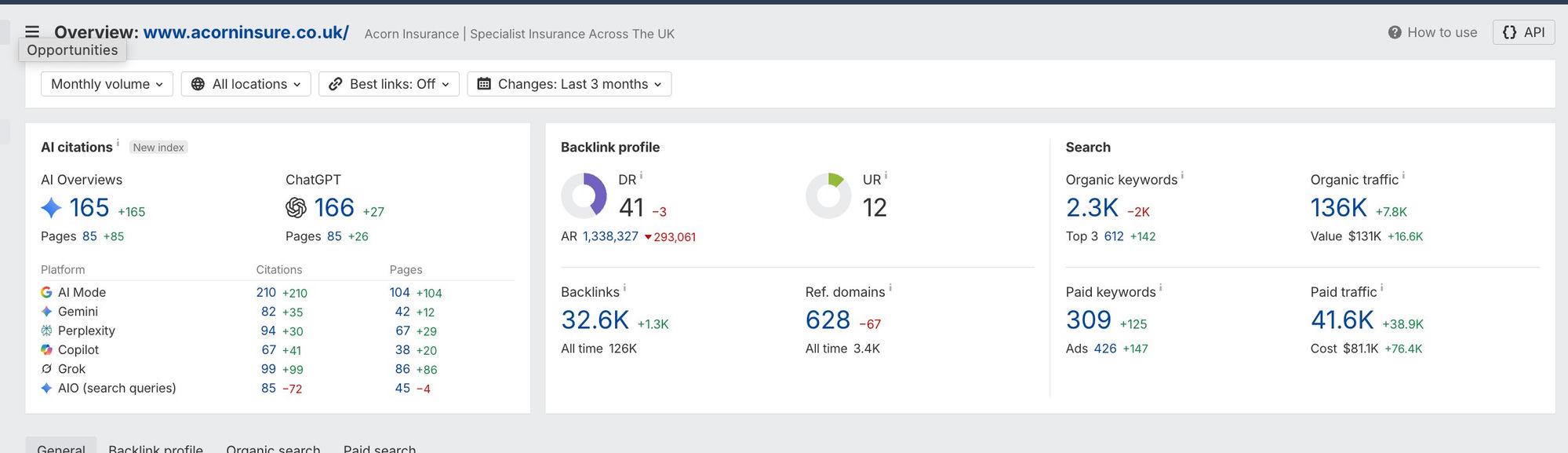
Ahrefs · acorninsure.co.uk · June 2026
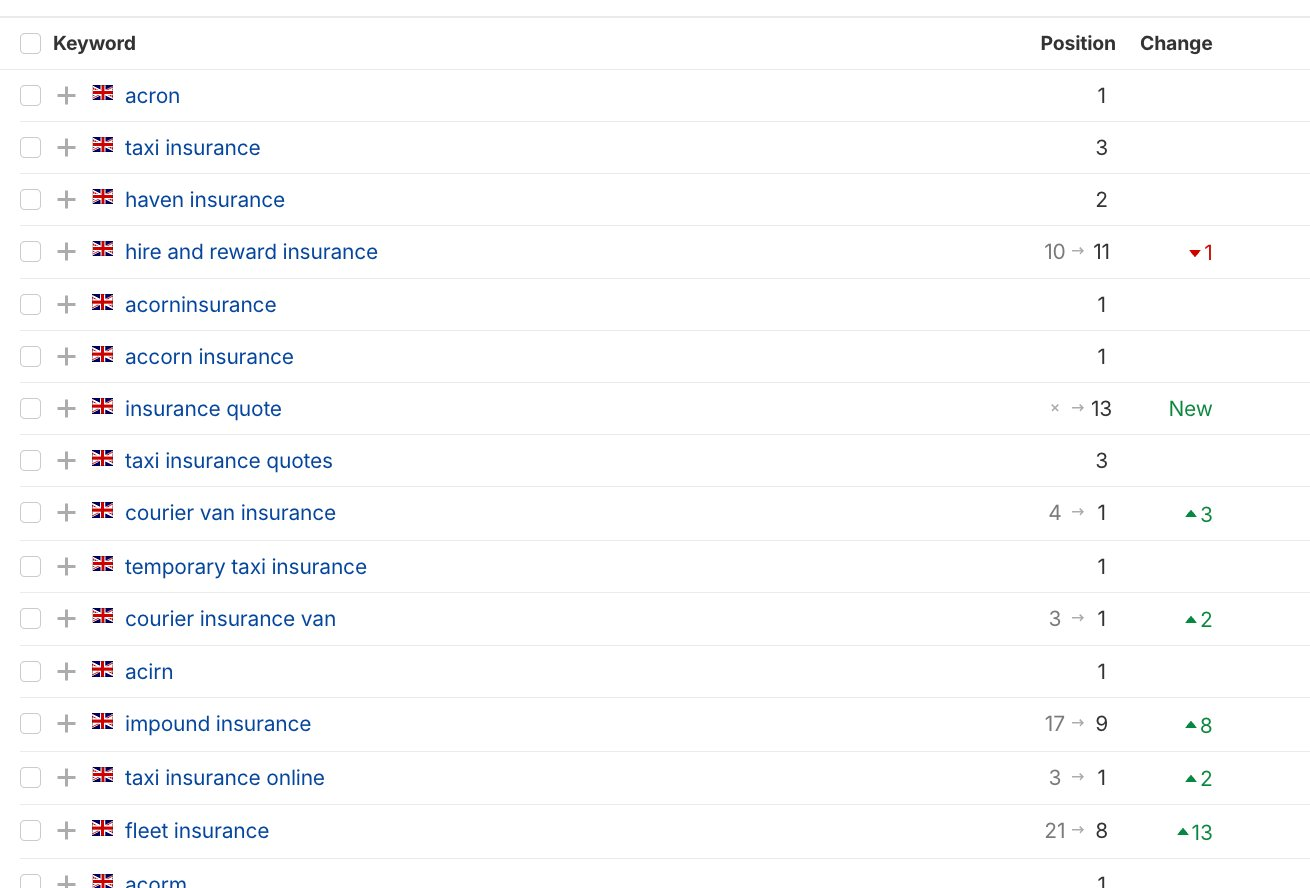
Top keyword positions · June 2026
Key Non-Branded Rankings
612 top-3 rankings from a single domain. In insurance. People searching these aren't browsing. They're buying.
Briefly
brieflycover.co.uk · Short-Term & Temporary Car Insurance
DR 12
Domain Rating
98.8K
Monthly traffic
£282K
Traffic value/mo
The number that stops you in your tracks
#2
"Temporary Car Insurance"
153,000 monthly searches. Domain Rating: 12. 30 referring domains.
This shouldn't be possible on raw authority. It is because every signal this domain sends says the same thing.
Key Non-Branded Rankings
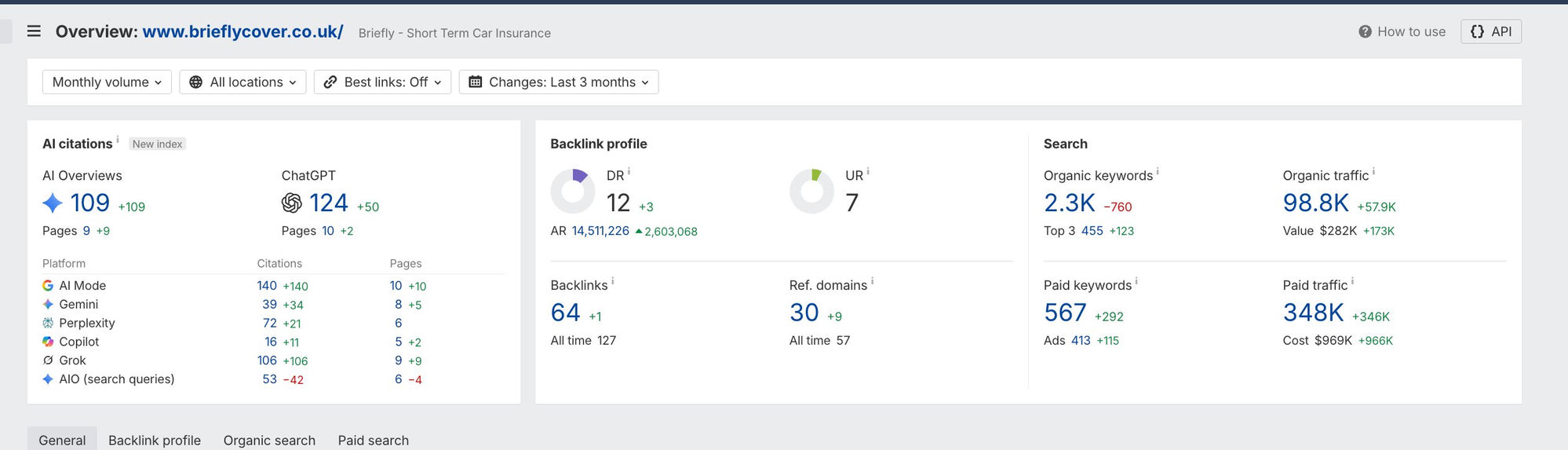
Ahrefs · brieflycover.co.uk · June 2026
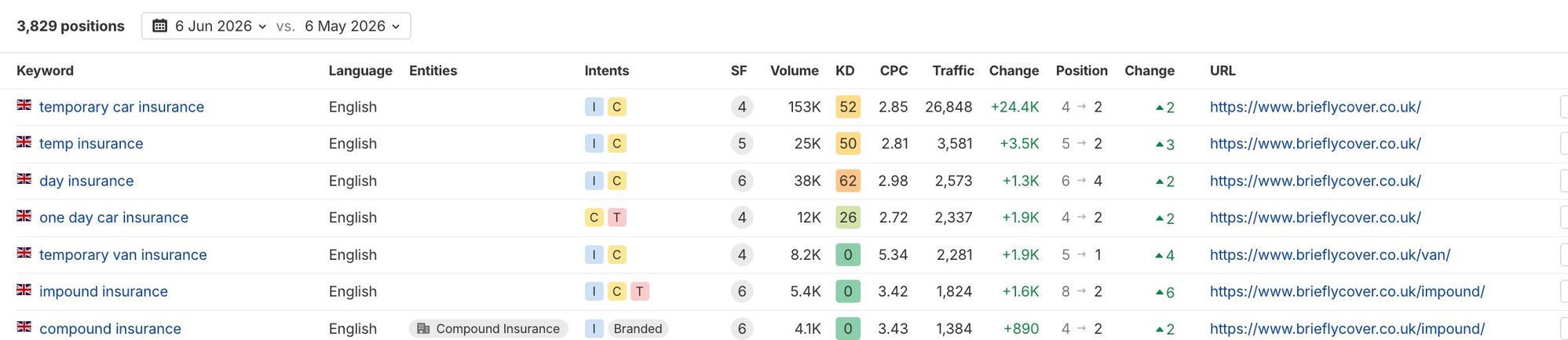
Keyword positions · brieflycover.co.uk · June 2026
Streetcover
streetcover.co.uk · Food Delivery & Courier Drivers
DR 6
Domain Rating
6.8K
Monthly traffic
£9.9K
Traffic value/mo
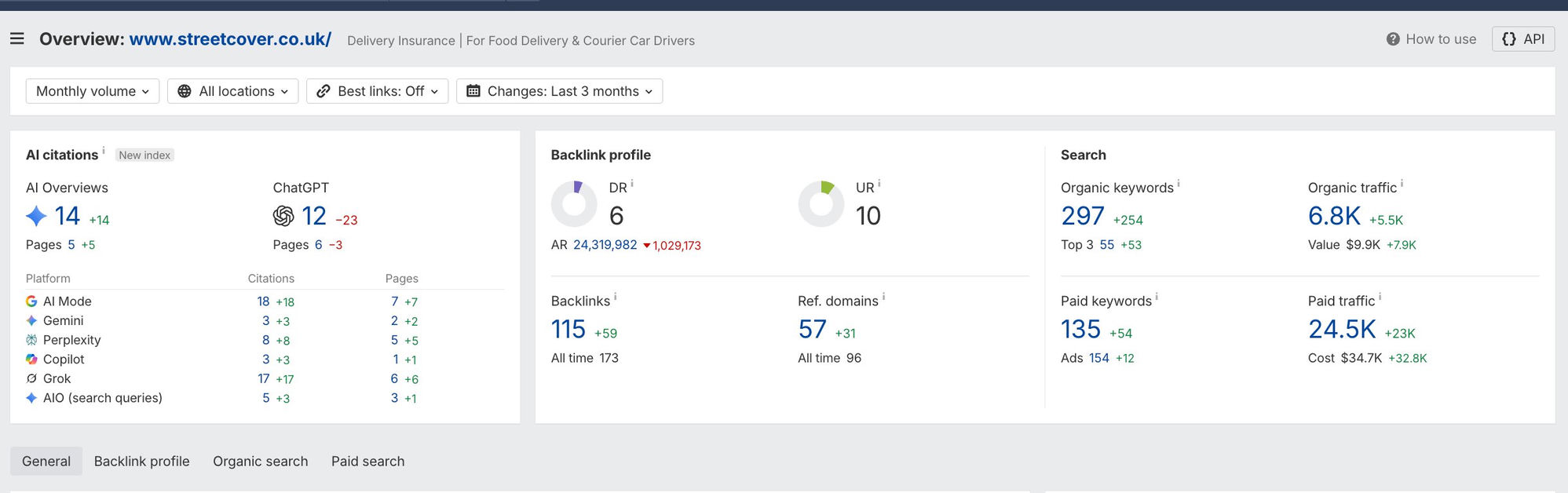
Ahrefs · streetcover.co.uk · June 2026
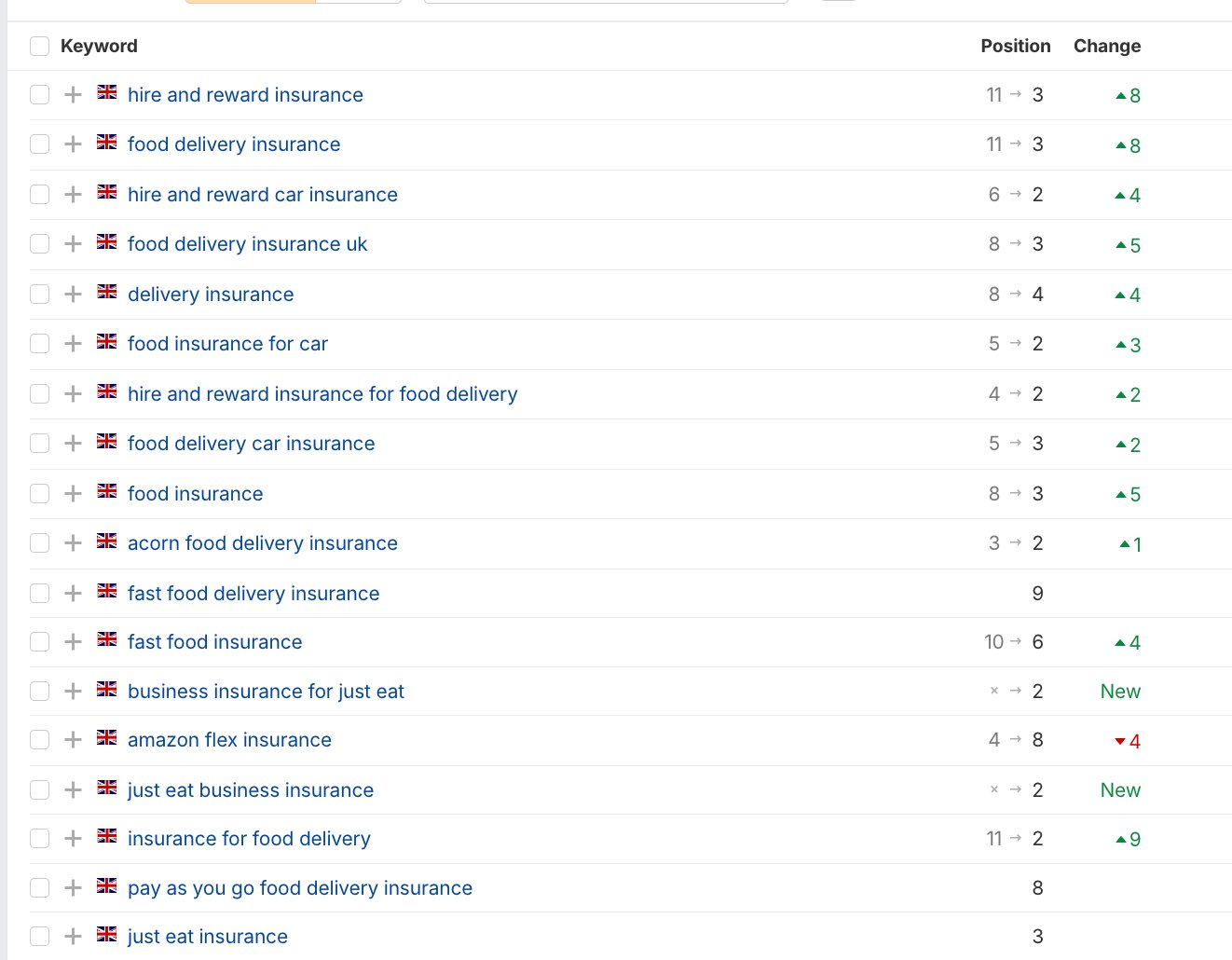
Keyword positions · June 2026
DR 6. Already Top 3.
The gig-economy insurance niche. Owned.
Newer. Smaller. Still building momentum. But the niche is real, the intent is commercial, and the gig economy is only growing. Watch this space.

Written by
Tom Riley
SEO consultant and agency founder. A decade of experience across insurance, finance and fintech.
I've spent a fair bit of time looking at Acorn Insurance and its wider domain portfolio.
In a manner of speaking, we were rivals. During my years working across delivery insurance and taxi insurance at Zego, we were often chasing the same customers. They never really came close to outranking us for our core target keywords, or competing with us for non-branded organic traffic across those product areas.
That said, I was always impressed by how they managed to rank multiple domains in the same insurance space. They have more than three, but for this piece I'm focusing on three key domains.
Most insurance companies are, frankly, still lost when it comes to search and SEO. Acorn, however, are doing extremely well.
Across these three brands, they generate more than 241,000 organic visits per month from Google. That traffic has an estimated monthly value of around £422,000.
I'm not sure whether this was a deliberate multi-domain strategy from the start, or whether Google's recent algorithm changes have simply played heavily into their hands. Either way, the results are impressive, and there are some genuinely useful insights to take from what they're doing and how it can be applied to other new insurance start ups or domains.
The direct traffic vs aggregator battle
Here is the problem every insurer is up against.
Most people looking for cover start on a comparison site, and those sites charge a fee for every lead they hand over. It is rented demand, and the rent is steep.
So if you can get customers coming to you directly, straight off Google, with nobody taking a cut in the middle, that changes the whole game.
So what is the reason for their success?
Well, it's not just one reason. SEO is broad and complex. We can never pinpoint it to a singular reason, however...
Why Acorn built three separate brands instead of one
Google rewards focus, but that focus has to be tied back to the source context of the website.
Source context is the commercial and topical identity of a site. It explains what the business actually offers, who it serves, how it makes money, and what area of expertise every page should support. In simple terms, it is the reason the website exists in search.
This matters because Google is not just judging one page in isolation. It is trying to understand whether the whole website makes sense as a source for that topic. If the content, product, audience, internal links and commercial offer all point in the same direction, the site becomes easier to understand and trust.
So the goal is not to publish random content around a broad niche. The goal is to build around a clear commercial offering, a specific audience, and the problems that audience needs solving. When someone searches, Google is more likely to send them to the site that looks like it was built for that exact person, product and intent.
A site trying to be everything to everyone is harder to trust, and that is exactly where most insurers slip up.
Acorn created separate brands for each of their product lines. When they deemed that the brand or product line moved too far away from the original customer base, they created a new domain and brand.
I'm not sure whether this is just them doing a brand play and the SEO being a byproduct, but either way it's smart.
Google loves sites that are tight on singular subjects, or niche specificity. This is almost a hack in the insurance world.
If you are able to base your homepage around a keyword, you require far less link authority to rank. You can naturally point links at your homepage (as most brands do) and by doing so, your main keyword, which also exists on your homepage, is now carried by the authority of that page.
Take a look at the temporary insurance search results.
You will see Briefly (an Acorn brand), Cuvva, Day Insure, Zixty and GoShorty all ranking with homepages. They are all temporary insurance brands.
These brands are saying to Google: this is who I am, and I am not leaving this lane. All of their strength gathers behind that single message, and it becomes very hard to beat.
Now you can apply this logic to any niche really.
Where most insurers go wrong and kill off their organic traffic is they start niche, then expand outwards. For example, if you sell to the gig economy (Uber insurance and so on) and have done this for a few years, and suddenly try to march into regular SDP young drivers insurance, well, good luck.
You'll be up against Marmalade, Ticker and other product lines and tight brands aimed at this sector.
Don't get me wrong, you will see Hastings and Admiral marching into any SERPs they want (search engine results pages) but this is a different story.
They do so off sheer domain authority, age and brand power. They are playing a completely different game to most insurance companies and you shouldn't try to replicate them.
I've seen sites completely kill their organic traffic by launching product lines in all different unconnected verticals. Not only does it confuse Google with the product being so semantically distant, but from a UX and brand signals perspective, a young driver probably expects a Marmalade site aimed at them rather than a generic insurer.
Now I'm using a car example here but I've seen worse. Sites selling niche car insurance move into pet insurance or home insurance.
As far as SEO goes, it just doesn't work. And by the way, SEO is the most important thing feeding AI search right now.
AI and LLMs will also recommend people to specific brands, but this is another topic.
Now product managers, CEOs, C-suite aren't thinking this way. They think in terms of aggregators, they follow revenue from this channel alone, without considering the path to organic revenue or the implications of new and existing product lines on organic traffic.
SEO is an afterthought.
But one thing I've noticed recently is AI has brought SEO back into focus. Suddenly AI is getting spoken about in boardrooms and the conversation naturally shifts to SEO.
But if brands commit some of the mistakes above it can be very, very hard to turn around the ship, sometimes not possible.
If you want to make sure a brand has a fighting chance in being recommended by LLMs (and I do not mean now, I mean a couple of years from now when they are operating at way higher levels of intelligence), they will understand us.
Our buying habits, our pets, our medications, our routines: everything they need to know about us to make a decision on who to recommend.
You need to make sure you have built a brand and a product for someone. That LLMs understand: you, your product line, who you serve, your reviews. You need to be built and marketed for somebody.
It is actually an extraordinary opportunity for the niche players to muscle in alongside large-scale insurers and brands. Because LLM search is more granular in how it serves its results. If you are a genuinely good fit for someone, you can be recommended.
But not everyone will be surfaced. Those who build bland, generic, wide product lines built for aggregators only may struggle.
And it is why a good SEO and brand marketer needs a seat at the table when growth decisions and directions get made. A good SEO is really a growth marketer who knows how to read the algorithm.
Picture a company that decides to launch three new product lines. Exciting on a spreadsheet. But nobody in the room realises it could quietly strangle the organic traffic that currently brings in the leads.
The opposite is true too. There are almost always semantically close products a company could move into, things closely related to what it already ranks for, where the traffic gains come quick and large. Most companies simply never spot them.
Acorn Insurance, Briefly, and Streetcover: the niche separation strategy
So back to Acorn. Whether by design or by instinct, they chose not to cram everything under one name. They built separate brands instead. Three of them tell the story well.
acorninsure.co.uk
133,000 clicks per month in organic Google search, across 2,300 keywords, 612 of which sit in the top 3 positions in Google. Worth an estimated £131,000 in equivalent PPC spend a month. Of course these are all third party metrics from Ahrefs and not Google itself, but it won't be far off. Outstanding results. Main keywords: taxi insurance #3, temporary taxi insurance #1, courier van insurance #1, taxi insurance online #1, impound insurance #9, fleet insurance #8.
brieflycover.co.uk
98,000 organic clicks per month from Google worth a whopping £282K in equivalent PPC spend. Now here's something interesting: this domain is a DR 12. This is the strength of the domain in terms of links, and it's not high at all. More on this below. Briefly is also running an estimated 348,000 clicks per month in PPC traffic. They are running paid ads, and this is one of the reasons for their success.
streetcover.co.uk
3rd in the UK for food delivery insurance (behind Zego in 1st, at least during my time there anyway). Also ranking for: hire and reward car insurance #2, insurance for food delivery #2, business insurance for Just Eat #2, food insurance for car #2, just eat insurance #3. All this in a very short space of time. Super low link authority but a changing algorithm that has played right into their hands. The playbook is the same again: 24,000 clicks per month in PPC traffic to fuel the organic and brand signals.
Now beyond that, if we were to get into more detail for Briefly.
As mentioned, they use their homepage with a tight brand focus on the topic. There is a clear H1 heading on the homepage targeting the term they want to rank for.
A full page that has been optimised for the core term throughout the headings and body content, with clear consideration given to UX and CRO.
Answering how much it costs on the page (a great heading and question for SEO and landing pages) slap bang on the homepage is just excellent UX.
Briefly is also running an estimated 348,000 clicks per month in PPC traffic. This is one of the reasons for their success.
Sites that run paid ads tend to rank higher. Don't ask me why, but they do. It has been proven time and time again. Google will tell us otherwise.
But here's my take: if you're running ads you're actively showing Google you want to be found, you're a brand, you exist, you're willing to spend.
Don't forget Google is trying to combat millions of AI-generated websites and content pages flooding the internet. Half of Google's job is just separating what's real from what's not.
Not only that, but probably the main reason ads cause ranking increases is the signals it sends to Google.
If users land on your page and stay and convert well, these are the signs you have a quality page. Google will be more open to showing this page in the organic results and the user signals are there.
All vital aspects to creating a high converting page. Conversions matter a lot for SEO. Sites that convert clicks stick around.
Google records click behaviour and user behaviour over long periods of time. If you don't match or better some of the other results, you will be removed as the experience isn't great for Google's users.
If you want to maintain your rankings you better focus on a site that matches user intent and conversion. This can be the thing offsetting link authority.
See why investing in brand and CRO is so important now.
CRO is allowing you to convert ads, which generates revenue. It sends user signals to Google that you are a quality result.
Your customers look you up more, causing branded search volume (a massive ranking factor these days). Existing customers and sign ups come back and look you up.
Google picks up on all of this and you start to rank organically.
The exact same strategy has played out for Streetcover, which we will go into shortly.
But hopefully the value of a brand, a visual identity, conversion rate optimisation, and an SEO that can map the page out correctly becomes clear. A lot of detail goes into all these steps. And suddenly you have a brand competing in national search results, not relying on aggregators, bringing in millions in revenue. All because the site was planned out correctly.
Ahrefs data · June 2026 · click any image to expand
£282K
a month · what Briefly's traffic would cost in Google Ads
How Streetcover ranks for competitive terms with almost no links
Here is a good example of building authority outside of traditional link building, one that is becoming more and more evident as a route to organic traffic in competitive markets.
Let me break it down. Streetcover has almost no link authority. A Domain Rating of 6 is tiny. On paper it has no business ranking for competitive insurance terms. And yet, there it is. How?
Because before the rankings came, they spent.
For a long stretch I saw Streetcover in every paid advertising slot going. They were buying their way in front of people, over and over. And in doing it they built a real brand, or at least one Google could see clearly: customers signing up, people typing the name into search, traffic arriving from every direction.
They tidied up the website itself too. But the big thing was the spread of signals they sent: social, paid, Meta, Google. They invested. And now that investment is paying them back in free organic rankings.
"Diversified traffic signals are becoming as important as links."
The Sweet Spot Trifecta
Signals
Traffic
Signals
Combine these and you are telling Google you are real, you are spending, people want what you sell.
It's no longer just about optimising a page as perfectly as it can be optimised, and building links. Don't get me wrong, links are massively important still.
But brand signals are a superpower, engagement signals are a superpower. Setting your brand up from the beginning and making every single 1% stack up is the superpower.
The £422,000 advertising bill Acorn does not pay
One phrase keeps coming up, so here it is in plain English.
Traffic value is simply what you would have to pay Google in ads to get the same visitors you are getting for free.
So when you see £422,900 a month across these three brands, that is the advertising bill Acorn are not paying. Briefly alone accounts for around £282,000 of it. That is demand they own outright, instead of renting it from a comparison site.
590 AI citations: how Google rankings get you into ChatGPT too
And there is a bonus they probably never planned for.
Ask ChatGPT how to insure a food delivery car, or ask Google's AI for the best temporary cover, and Acorn's brands turn up in the answers. Close to 590 times, across Google's AI Overviews and ChatGPT, at last count.
"That is not bought. It comes from being a focused, clear source on each subject."
What every insurance brand can learn from Acorn's SEO playbook
The core move is straightforward: build dedicated branded domains around tight topics and specific product lines. Not a sprawling generalist site trying to rank for everything. A focused domain that owns one corner of the market completely.
Then do not start with SEO. Start with digital marketing basics. Create demand first. Run ads. Build social signals. Drive referral traffic. Get real users engaging with a real product. Google picks up on those demand signals and rewards the site with non-branded organic rankings it would never have earned on links and content alone.
The Acorn playbook, step by step
Branded Domain
Tight topic, specific product line
Digital Marketing Basics
Paid ads, social, referral, direct
Create Demand
Real users, real engagement, brand searches
Optimise the Site
Technical SEO, UX, CRO, content, links
Google Rewards Demand
Algorithm reads the signals across the board
Non-Branded Rankings
Organic visibility compounds without paid spend
Branded Domain
Tight topic, specific product line
Digital Marketing Basics
Paid ads, social, referral, direct
Create Demand
Real users, real engagement, brand searches
Non-Branded Rankings
Organic visibility compounds without paid spend
Google Rewards Demand
Algorithm reads the signals across the board
Optimise the Site
Technical SEO, UX, CRO, content, links
Everything else SEO wise still applies. We still need high level optimisation and links.
But the skill set has widened. You need to understand brand, CRO, UX, diversified traffic signals.
If you can act like a real brand trying to bring their product to market through digital advertising, social ads, brand traffic, referral traffic and more, as well as doing top level SEO, that is a winning combination.
What fuels modern SEO and AI recommendations for insurance brands
All signals. One outcome.
| UX + CRO How users behave on your site, including dwell time, engagement signals, conversions | Brand traffic People searching for you by name | Product market fit A product built for a specific person |
| Diversified traffic Ads, socials, referral, direct | Technical SEO Structure, speed, crawlability | Headings + entities Semantics, topical signals, schema |
| Topical authority Owning a subject end to end | Links Still important. Always will be. | AI visibility Citations across LLMs and AI Overviews |
Reverse engineering the algorithm got harder as there is more to take in. But if you are a good marketer, a holistic marketer, you will do more than ok for brands.
Tom Riley's Recommended Approach
SEO Consultant
- +
Dedicated domains for dedicated niches. No confusion about what each site is for and who it serves.
- +
Do not skimp on visual identity, brand and design. This is the foundation of your website. It makes everything else work harder.
- +
Clear money pages for each product line.
- +
Use Google Ads and Meta Ads to genuinely carve out demand for your product and grow branded traffic.
- +
Digital PR, niche-specific news links, and entity stacking.
- +
Earn organic Google positions and LLM traffic will follow.
About the author
Tom Riley
Founder, HAKKEN
Tom Riley is a UK SEO consultant and founder of HAKKEN, an organic growth studio helping brands grow their direct traffic, visibility, and revenue through SEO, content, and AI search. His work spans technical SEO, content strategy, and AI search visibility, with a focus on competitive industries like insurance, fintech, and health.
The full data breakdown follows below.
Get the Playbook
Straight to Your Inbox.
Every week I send out what's actually working in SEO and AI search, breakdowns, teardowns, and the strategy behind them. No filler. No fluff. Real analysis you can act on.
Join the list. Be first to get the next one.