Tom Riley
Founder, HAKKEN · 10 min read
In This Article
None of Marshmallow's commercial keywords rank in search.
Source: Ahrefs · June 2026. Monthly search volumes are UK estimates.
Marshmallow is a UK insurtech, founded 2017, a profitable, excellent company and visually one of the most beautiful if not the very best website in UK insurance, certainly from a visual identity perspective.
On the surface, their SEO looks ok according to third party tools. Ahrefs puts organic traffic at 36,000 a month. The reality is their SEO brings in virtually nothing in terms of commercially orientated traffic. Here I'm going to fix their entire SEO strategy in a ten minute read.
Let's unpick this. Firstly we should filter out their brand name. SEO isn't about ranking for your brand name. The role of brand and search is a separate topic but it's not the job of an SEO to rank your brand name; it happens naturally, branded traffic is not 'SEO traffic'.
The role of SEO is to bring in traffic when customers are searching for your products and services. To make them aware of your products and services and to cover all levels of the funnel that might lead someone to a purchase. But the reality is in high stakes SERPs like insurance, it's ranking for your bottom-of-funnel product keywords, to bring in traffic and sales and leads. In order to do that in Google's current algorithm you have to rank at the top of the search results.
Google is a method of direct acquisition that can give you life outside of the aggregators. Millions in recurring revenue can be gained from ranking in search in insurance.
Marshmallow's SEO is doing nothing of the sort. This write-up will break down exactly why. In a relatively short space of time, I'm going to give the whole strategy upfront. None of what I'm highlighting is that complex either, simple stuff in terms of SEO.
36,000 organic visits a month. Strip out the branded searches and you're left with virtually nothing.
Firstly, let's take a look at the aggregators. The price comparison giants like Compare the Market and MoneySuperMarket are built almost entirely off the back of organic search. They spend hundreds of thousands a year on SEO backlinks in the form of digital PR direct to their product pages to maintain their rankings for commercial traffic. They understand SEO better than all the insurance companies that pay them, and this is why they exist. Type in car insurance, they appear. Type in home insurance, they appear. Not through chance, but through design and a lot of investment in SEO.
And the numbers are staggering. MONY Group (MoneySuperMarket) posted record revenue of £446.3m in their 2025 full year results, with adjusted EBITDA of £145.1m. Compare the Market pulled in £563.7m in its most recent reported year (to June 2024), at over £220m pre-tax profit. And it's not just the big two. Confused.com turned over £172.5m in 2024, and GoCompare posted £72.3m in pre-tax profit in its year to September 2024. These are businesses turning search demand into hundreds of millions, year after year.
Now heading back to Marshmallow. It's worth noting that branded traffic is the best form of traffic you can get, and Marshmallow gets lots of it, better than most. However, outside of that we have paid traffic and organic search. I'm not even sure if Marshmallow are on the aggregators or not, but regardless, SEO is business, and it doesn't make sense in my opinion not to fix the things we're about to discuss. Because of the authority and trust of their domain, particularly in certain areas, they should be able to see some very rapid results.
Where the traffic actually comes from
The Traffic Problem:
It's Almost All Branded.
So what happens when we start looking at what that traffic is and where it comes from.
Firstly it's worth pointing out 36k estimated per month isn't large by any means in insurance. For a DR 56 (link power) who have the brand power of Marshmallow (measured in branded search demand and brand + keyword traffic), branded search demand puts SEO on steroids; they should have way more positions than they currently do for commercial keywords, and a lot higher traffic.
And it's worth pointing out that everything in SEO is relative. I'm critiquing Marshmallow's SEO because their domain strength, in terms of link equity, combined with their branded traffic means they have the firepower to compete in the UK insurance SERPs (search engine results pages). The fixes they need to implement are, relatively speaking, small. Compared to some companies' SEO problems, this is straightforward. They are vastly underperforming given what they have to work with, which is the reason for this post. I wouldn't point out companies who are lagging behind in authority, but when it's simple on-page fixes it begs the question why.
So when I say DR, this is Ahrefs' measure of domain rating, or backlink strength. Whilst 56 is not the biggest in insurance, it's certainly not low; these DR numbers need taking with a pinch of salt, the links themselves are way more important than the number, which can easily be manipulated, but that's another story. The point is, relative to their domain strength, they are underperforming.
The image below shows their highest traffic pages once I've filtered out their brand name. As you can see, it's all blog traffic.
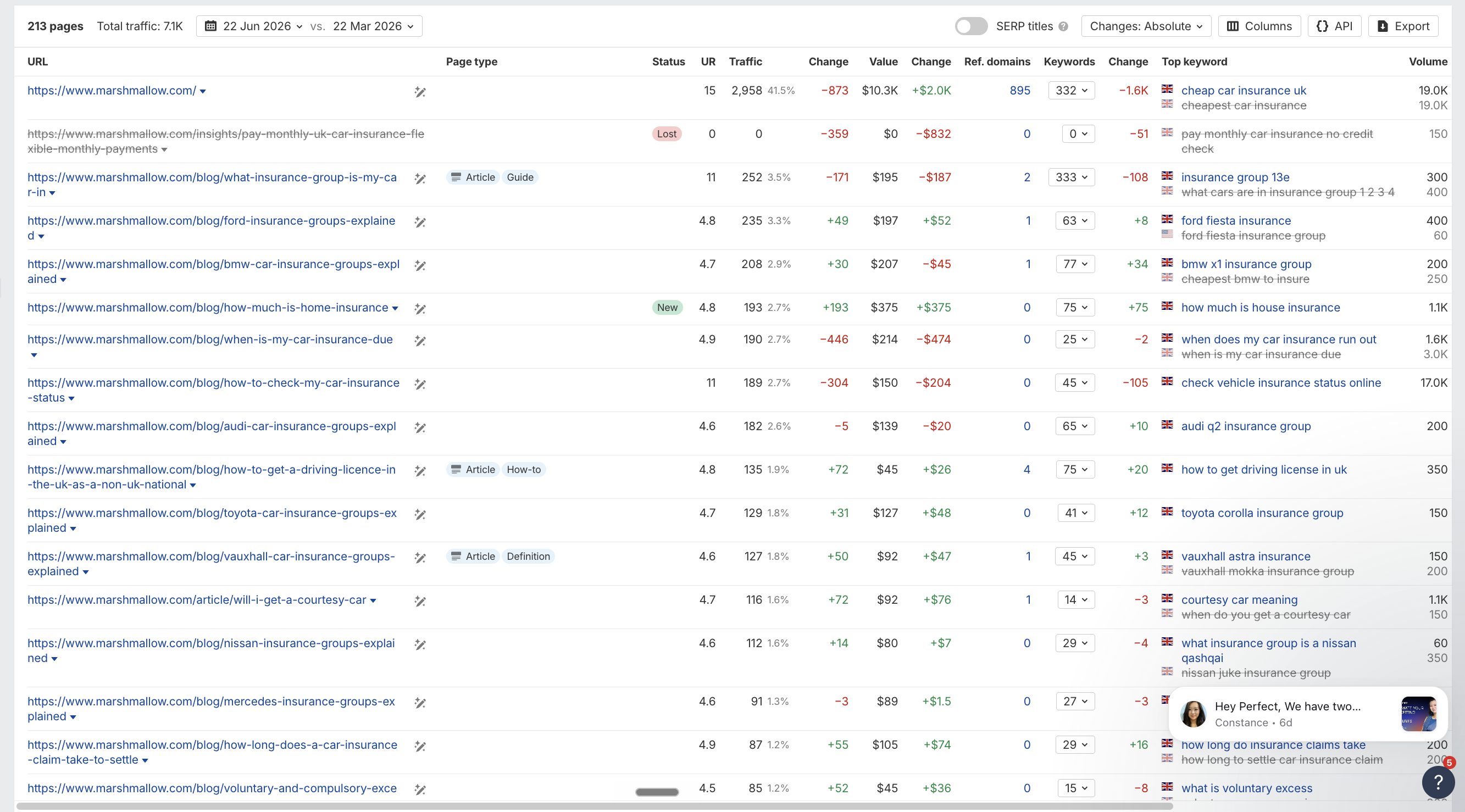
Ahrefs · marshmallow.com · page-level organic traffic · June 2026
Whilst blog traffic is great it has a use case; it rarely leads directly to sales. In SEO we use blog or informational traffic to help build up topical authority and trust to the domain, we can then link from powerful pages that bring in traffic to core commercial pages to help them rank. It also serves for brand awareness purposes but the reality is it's a means to an end of ranking commercial pages, or at least that's how I've always seen it.
So now let's filter out blog and see what commercial pages are ranking.
What we're left with is well… not much. A homepage running in 7th for 'cheap car insurance UK' which will almost certainly be an overestimation of traffic, in this case it simply ranks because they have 'cheap car insurance' in their meta title. And then a bunch of product pages ranking for absolutely nothing.
A brand with hundreds, likely thousands, of branded searches a day coming to the domain, and their product pages rank for absolutely nothing.
So why is this? Why does a brand with hundreds, likely thousands, of branded searches a day coming to the domain not compete in search for commercial keywords?
Well, very simply, main reason at least, it's because they went too far on brand at the expense of on-page SEO. And this is actually the reasoning behind this post, because it's frustrating to see brands have the power to compete but just lack the knowledge of why they don't rank.
Maybe they don't want to rank for their products and keywords. Maybe they do that well from a brand perspective and the 50,000 searches for van insurance per month don't matter to them. But I doubt it. So let's fix it.
Google ranks pages, not websites
Your domain's authority gives every page on your site a head start. But each individual page still needs to earn its own rankings. Domain Rating is the ceiling, on-page SEO determines how close you get to it.
Branded traffic is not SEO working
When someone types 'Marshmallow car insurance', that's brand recognition converting to a click. SEO is about capturing people who don't know you yet, people searching 'van insurance' or 'home insurance' with no brand in mind.
The three on-page elements Google checks first
URL slug, meta title, H1. These are the three places Google looks first to understand what a page is about. They need to be somewhat aligned.
Product page teardown: van insurance
The Van Insurance Page:
Google Has No Idea.
Firstly let's start on one of their product pages. Van insurance.
Marshmallow's positions here are non-existent, they rank for nothing inside the top 100 results. Google has no clue what they do, which is a repeating pattern across most of their product pages. They rank for two keywords: 'marshmallow van insurance' and 'van insurance marshmallow'. Branded terms, that's it.
A healthy page should rank for hundreds of non-branded queries (when I say queries, I'm referring to what shows up inside Google Search Console at a page level). For those that don't know, Google doesn't rank websites, it ranks pages. Pages that exist and take strength from the website they sit on but fundamentally need to be optimised, that is what Google is showing.
Give Google context: headings and terms
The primary keyword "van insurance" does not appear in the H1 or any H2 heading. Google has no clear picture of what this page covers.
The H1 reads: "Get the job done with van cover." Google has no clue what this page is about.
Van insurance is not mentioned in the H1, or any H2 headings. As such, Google has no clear indication this page is about van insurance. This needs correcting at a basic level, give Google some context as to what the page is about. Remember, Google cannot read. It needs consistent, clear cues, and right now there are none.
Beyond fixing the H1, we also need supporting headings that cover topics relevant to the page. This is where it gets more interesting. We don't just guess what those headings should be, we reverse-engineer the search results that Google is rewarding. As Kyle Roof once said, Google plays poker with its hands face-up; it's literally telling you what it ranks. So we head to Google and conduct what is known as SERP analysis. What is Google already ranking for this query? What are users actually searching for? What questions are they asking around van insurance? How are the pages structured? What common topics do they cover? How does our brand fit in here? What are the common phrases I need to cover? (There are tools that help here.)
It could be something like "What's the difference between business and standard van insurance?" or "How much does van insurance cost?", we may well need to mention Third Party Fire and Theft in a heading. Who knows at this stage. This is exactly where SERP analysis comes in: we audit what Google is ranking, look at what our users' research pain points are, and work out what topics Google considers important for users searching this term. Then we make sure those topics are present on the page.
"Search engines try to mimic what searchers want. Approach everything from that perspective."
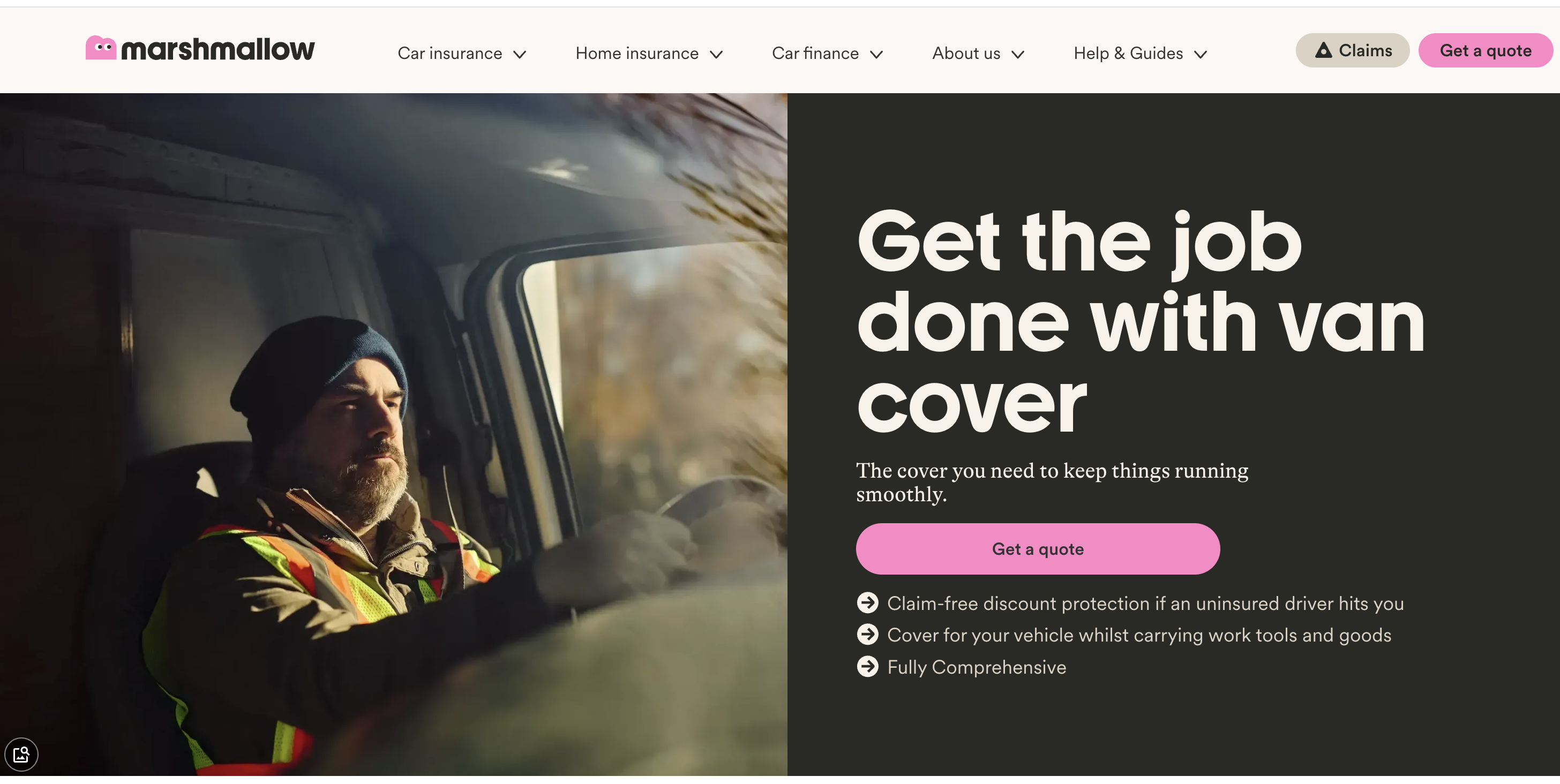
Marshmallow.com · van insurance page · H1 contains no primary keyword
We next look at the associated terms which add context to Google. Any on-page tool will be of use here to recommend the terms we should be incorporating into the page. They are all pretty much the same, all will put you somewhere in the correct ballpark, so Google understands, or at least helps understand alongside the headings, what the page is and who it should be shown for.
Their meta title is 'award winning cheap van insurance'. This is non-optimal. Ideally here you pull the main keyword to the left, optionally adding a branded line to enhance CTR. The main context here is van insurance. Meta titles are for Google, we're telling Google what we do.
A look at the SERPs would reveal most domains opt for van insurance as the leading word (the normal strategy for ranking commercial pages) and a few insert 'cheap' or other short terms in front. 'Van Insurance | Award Winning Cover | Marshmallow' keeps the keyword first, communicates quality to the searcher, and brands cleanly at the end. They need to fix this meta title, a common problem across all product pages.
URL Slug
Current
/van-insurance
Tells Google the topic at the URL level. Marshmallow's slug is actually fine here, the problem is everything that follows it.
Meta Title
Current
award winning cheap van insurance
Should be
Van Insurance | Award Winning Cover | Marshmallow
Lead with the keyword. Brand goes on the right. Every word you put in front of the primary keyword dilutes its importance to Google.
H1 Heading
Current
Get the job done with van cover
Should be
Van Insurance
The single most important on-page element. It should match what people are searching for, not a brand tagline. Google reads this first.
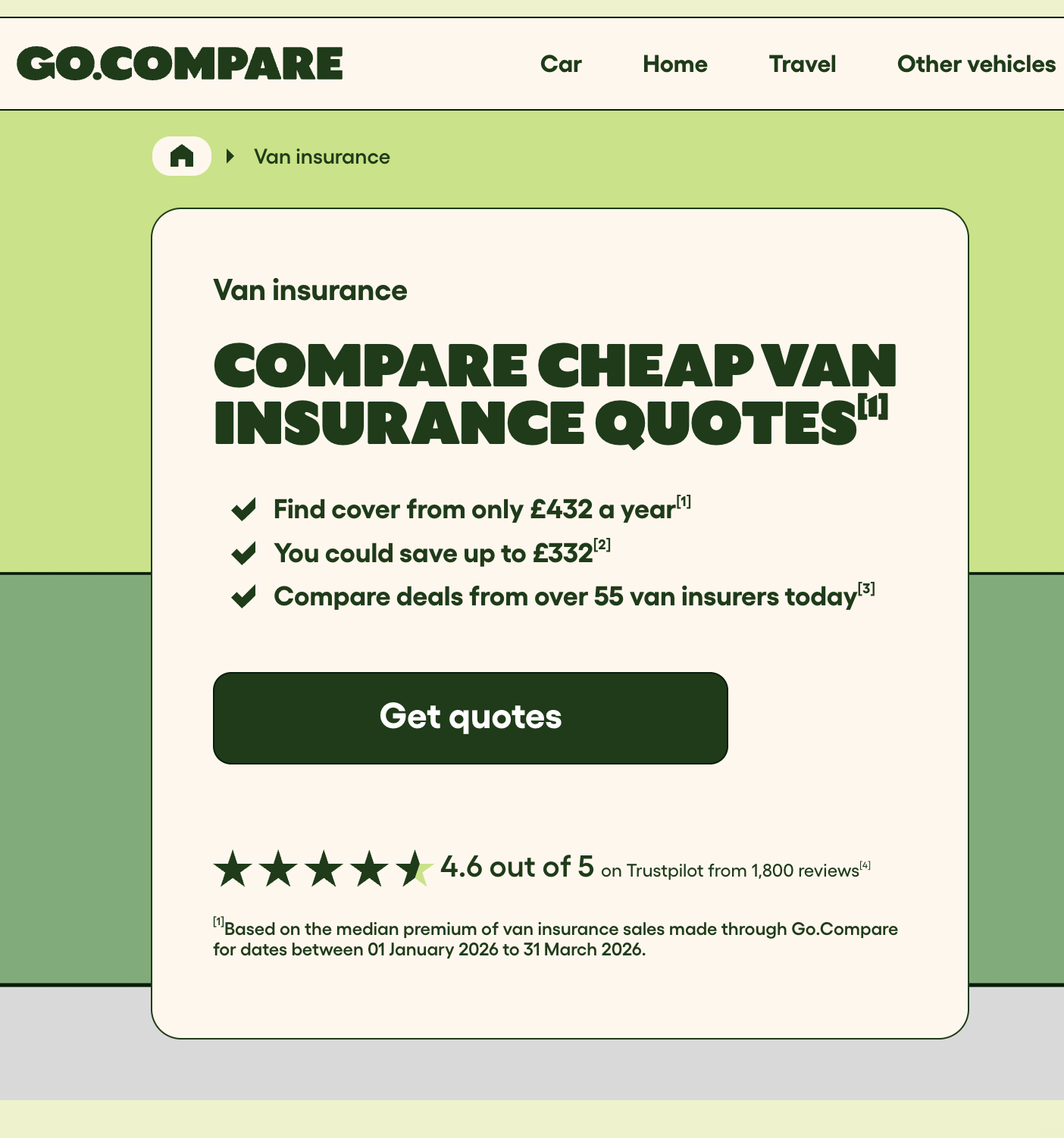
Go.Compare · van insurance page · top 3
Go.Compare sits in the top 3 for van insurance (50,000 searches/month), capitalising on mass search demand. It starts with basic on-page optimisation. The H1 heading is 'van insurance' dropped smaller for CRO purposes so the brand heading can take center stage.
Notice the smaller dropped "Van Insurance" heading, the H1, written for crawlers and SEO. "Compare cheap van insurance quotes" is an H2, the large branded heading users see first. Google reads the H1 to understand the page. Users get the brand experience from the H2. Both can co-exist.
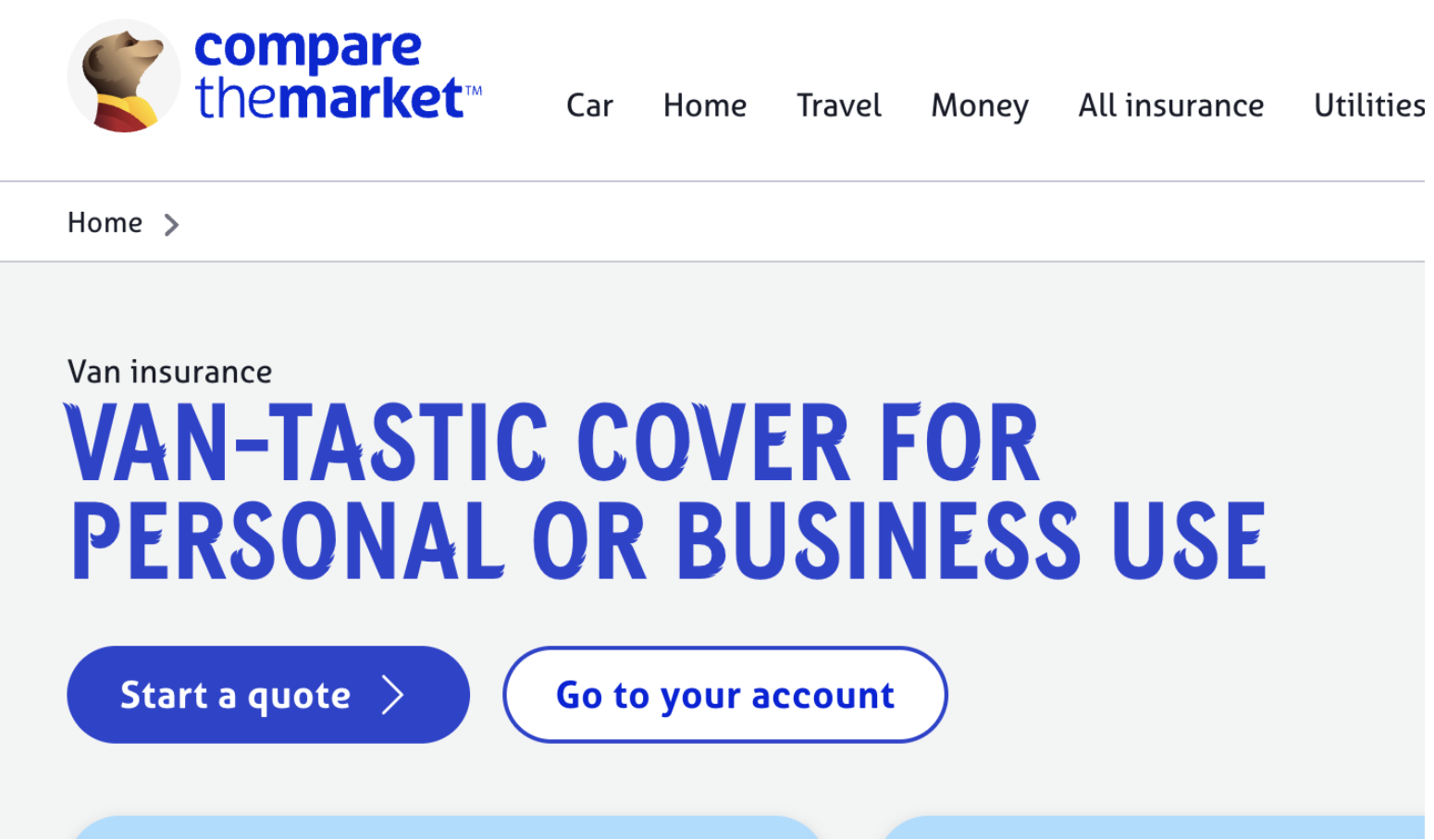
Compare the Market · van insurance page · top 3
Compare the Market sits in the top 3 for van insurance (50,000 searches/month), capitalising on mass search demand. It starts with basic on-page optimisation.
Exactly the same pattern. The small "Van insurance" above is the H1, what Google reads. The large "Van-tastic cover for personal or business use" is the H2, the branded experience. Every major aggregator plays it this way.
Above we've shown a simple example of how to place an SEO heading into the page without it dominating the branded heading. It's clear that the optimal H1 to rank is 'van insurance', unfortunately 'get the job done with van cover' doesn't mention either vans or insurance, so it can't work.
Next we look at the page itself. Simply put, and I am simplifying here, Google next looks at the other headings on the page to derive context as to what the page is about, followed by the terms on the page, entities, semantically related words which back up knowledge of the product or service, closely aligned with what Google understands the topic to be about.
So similar to the H1 heading, you can't go too far with brand here. It needs balance: headings for crawlers, brand and CRO element strategically placed without compromising SEO.
Notice in the comparison below, apart from Go Compare which is being blocked by the domain, the rest of the sites have an on-page score of above 70. Now this score isn't gospel, as with all on-page tools it's a guide, nothing more. Are you hitting the right ballpark?
Now let's look at Marshmallow's page. As you can see, it's way off the mark.
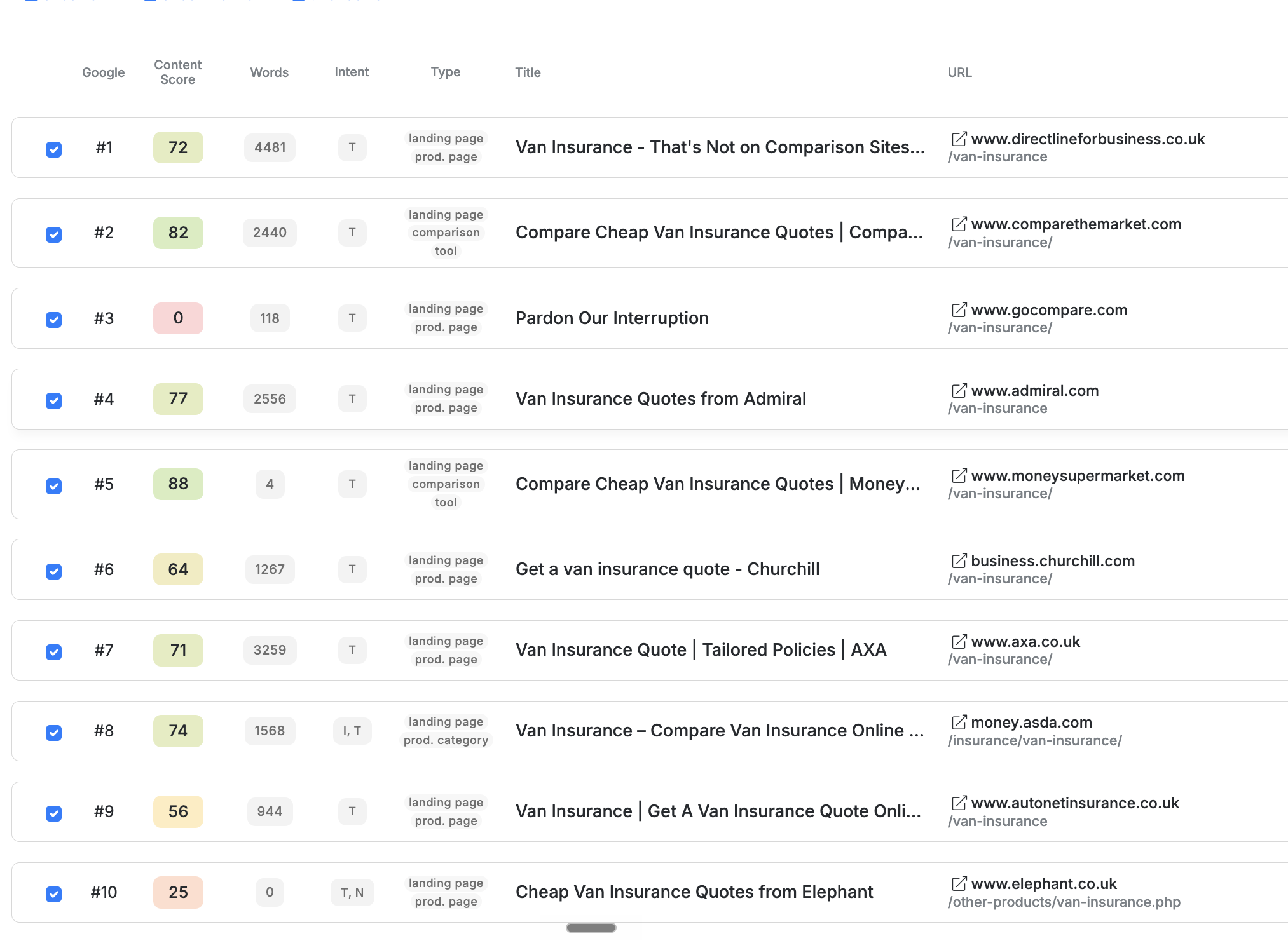
Van insurance SERP · content score comparison · top 10 results
Average 'content score' above 70.
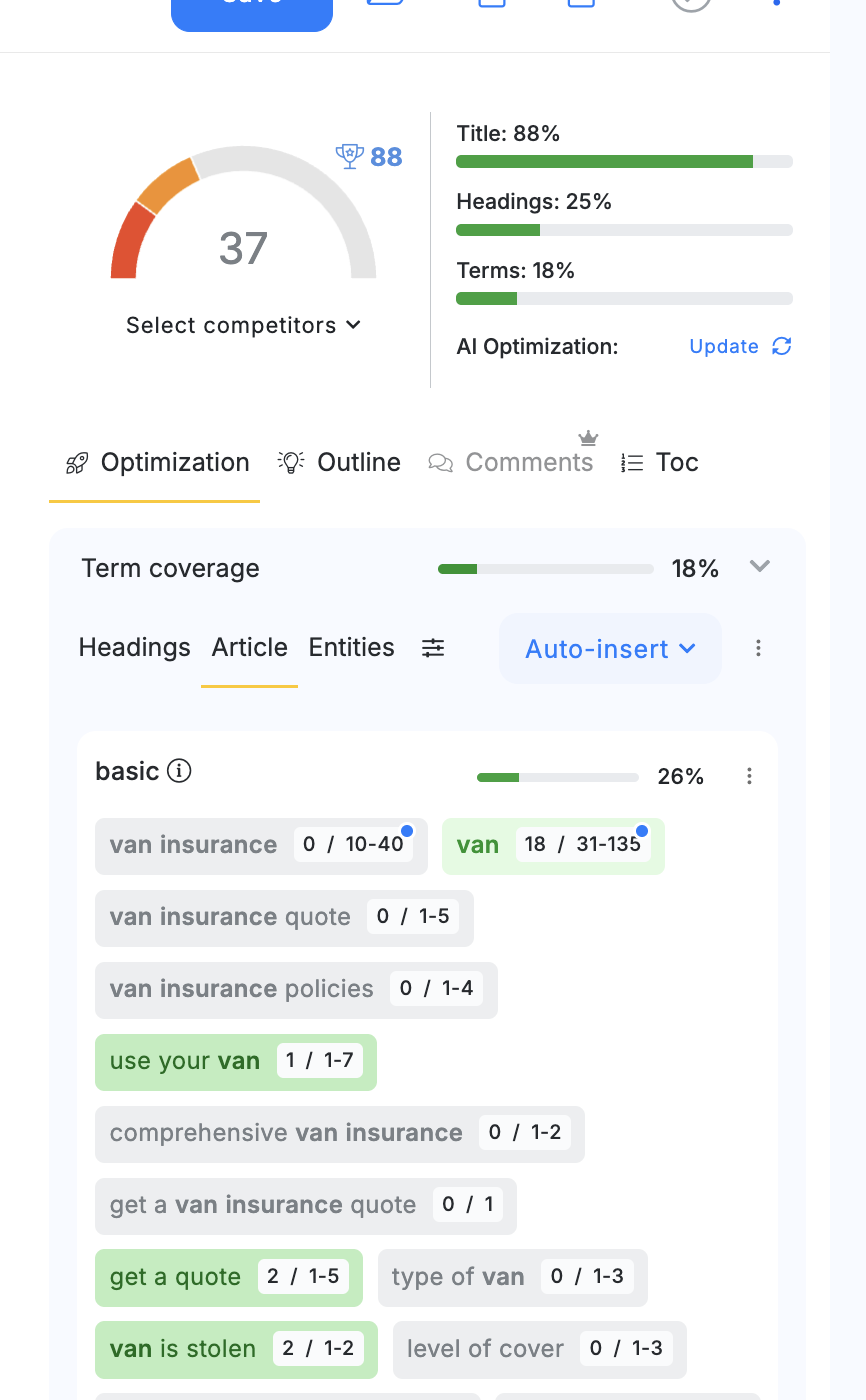
Surfer SEO · Marshmallow van insurance page · content score 37/88 · critical terms missing
This is a one-day fix. After a few weeks I'd be looking inside Google Search Console to see if we are recruiting more commercial queries to the page. We should see these popping up in Search Console after the reoptimisation, positions would start to improve across the board. The 'van insurance' position line right now, I'd hedge a guess, would look like a broken intermittent line in their GSC report. After fixes we should see solid lines across many queries climbing nicely.
Now we're not finished there. We need to work through every single product page doing the same thing, this doesn't just apply to van, but car insurance, and every other product line where they have zero commercial search positions. We need to reverse-engineer the SERPs for every commercial query without sacrificing UX and brand.
20% of SEO gets 80% of the results. You can't afford not to have optimised pages. At the basics: H1, slug, meta. We can't mess this bit up.
The home insurance page vs page one
The Salience Gap:
Marshmallow Barely Names What It Sells.
But to be honest, on-page is where the site falls down across the board. All the blog content and internal linking effort is somewhat wasted when the page it points to has the wrong heading. It's useless linking to a page with the anchor 'home insurance' when the page isn't optimised.
| Page | Actual H1 | Target keyword |
|---|---|---|
| Van insurance | Get the job done with van cover | van insurance |
| Home insurance | Get home insurance in minutes | home insurance |
| Expat car insurance | Car. Kar. Auto. Motokā. Voertuig. Mota. | car insurance for expats |
| Black box / Telematics | Get our cheapest car insurance with Marshmallow Move | black box / telematics insurance |
| Car insurance | Cheap car insurance for UK newcomers | car insurance |
In most cases the H1 does not contain the primary keyword. Google's most important on-page element is pointing at nothing.
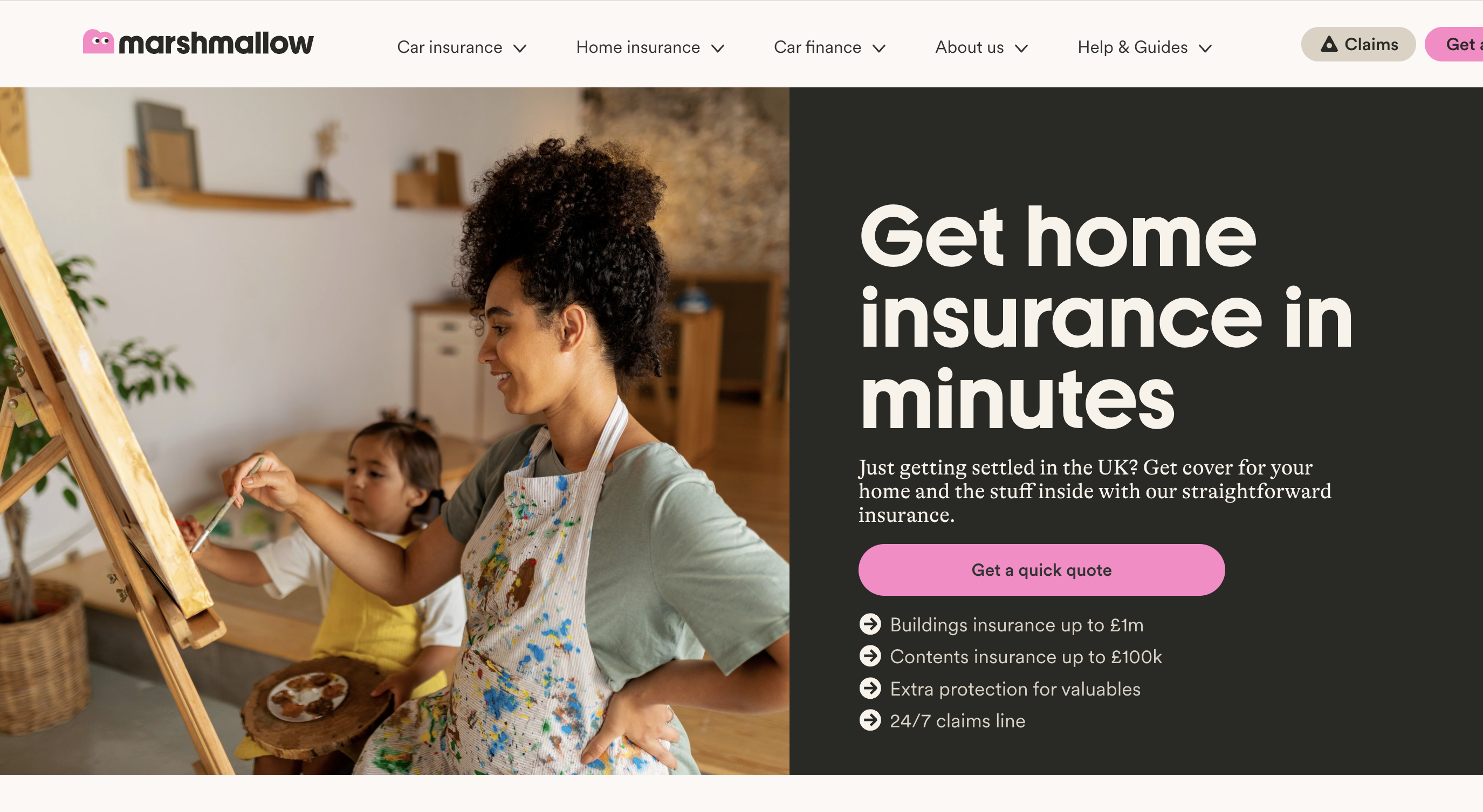
Marshmallow.com · home insurance page · beautiful design, minimal keyword presence
"Home insurance" does not appear in the H1 as a lead keyword. Only two H2s reference it at all. The page gives Google almost nothing to work with.
| Site | Position | In Content | In Headings | Total |
|---|---|---|---|---|
| Marshmallow | Not ranked (top 15) | 1 | 2 | 3 |
| Aviva | #1 | 19 | 10 | 29 |
| Compare the Market | #2 | 44 | 13 | 57 |
| Uswitch | #3 | 16 | 17 | 33 |
| MoneySuperMarket | #4 | 76 | 16 | 92 |
| Allianz | #6 | 67 | 23 | 90 |
| MoneySavingExpert | #7 | 26 | 8 | 34 |
| AXA | #9 | 5 | 3 | 7 |
Marshmallow: 1 mention in content, 2 in headings, 3 total. Every ranking page uses it 7–92 times, with 8–23 appearances in headings alone. It barely names the thing it's trying to rank for.
Marshmallow mentions "home insurance" 3 times on their home insurance page. Every site ranking above them uses it between 7 and 92 times.
For comparison, here is the site that ranks number one for home insurance, and lets other insurance companies list on their website and takes a cut of everyone's profits. Compare the Market's home insurance page below.
"Home insurance" appears in the H1, in six separate H2s, and throughout the page copy. Google has no ambiguity about what the page is about.
Is SEO about shoehorning your primary keyword across a page thousands of times? No. But you do need to give Google some meaning, a little hint as to what the page is about.
Their Core Product:
Ranking 7th When They Should Own 1st.
So far I've shown an example of a product page (van insurance), touched on blog, dissected the home insurance page a bit, but the reality is everything I'm saying applies to all product pages. Nothing is optimised. These strategies could be applied to every product page.
Now, their core product, or at least their initial product, looks to be 'car insurance for expats'. They rank 7th. They could take 1st for this pretty instantly, they are strongly associated with this query. They should certainly be number one.
Car insurance for expats. Their founding product. The term the entire brand was built around. They rank 7th.
Look at the sites ranking 1st, their meta titles vs Marshmallow's below. Completely misaligned slug and meta title. Click into the page and the H1 heading, well, you can see what it is. The H1, the meta title, the slug, all completely misaligned. They could take number one for this in a couple of hours' work.
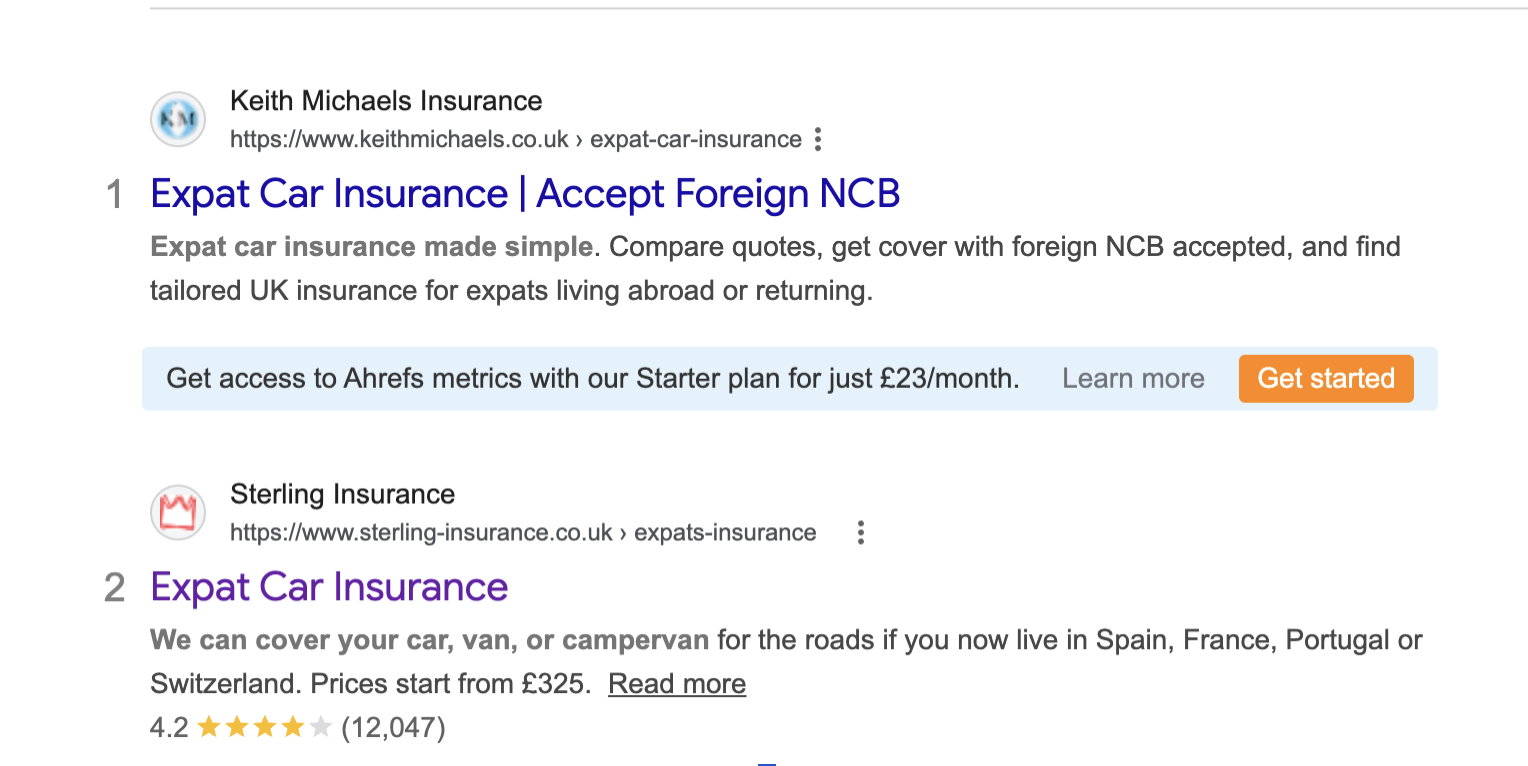
Google SERP · 'expat car insurance' · Keith Michaels #1 · Sterling #2 · both title tags aligned to the search term
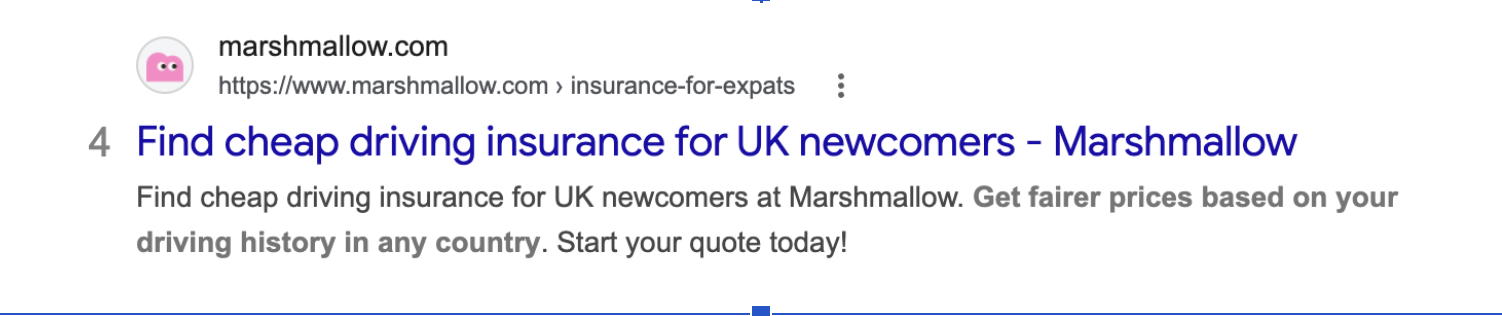
marshmallow.com · 'car insurance for expats' SERP · title: "Find cheap driving insurance for UK newcomers"
The title tag doesn't contain "car insurance for expats" anywhere. Google is ranking them despite this, not because of it.
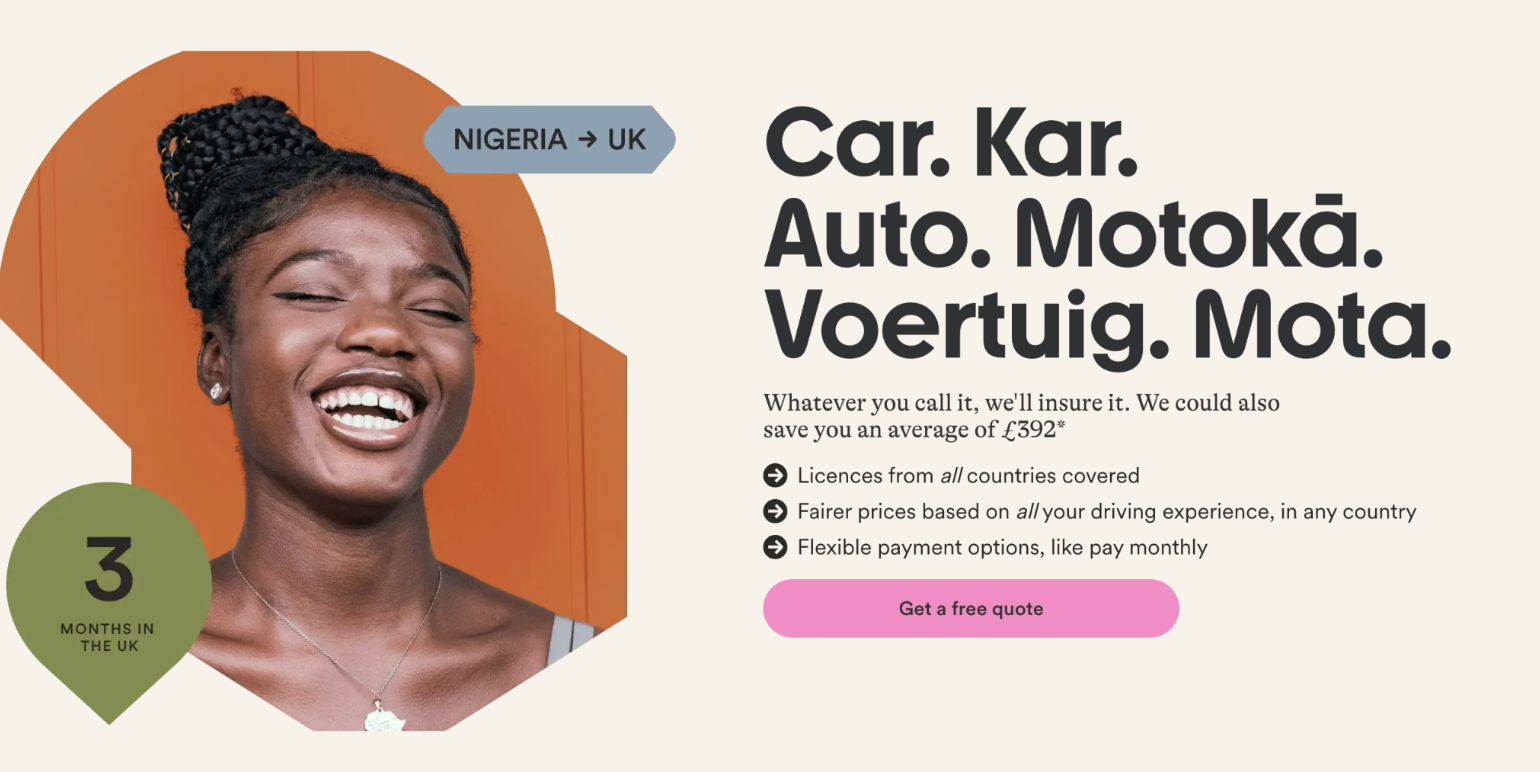
marshmallow.com · insurance for expats page · H1: "Car. Kar. Auto. Motokā. Voertuig. Mota."
Beautiful. And completely invisible to Google. The words "car insurance for expats" do not appear in the H1. The page Google uses to understand what this page is about says nothing about what it's trying to rank for.
URL Slug
Misaligned
Does not contain the target keyword phrase
Meta Title
Misaligned
Does not lead with the primary search intent
H1 Heading
Misaligned
Does not reflect what the user searched for
When slug, title, and H1 don't agree, Google has no clear picture of the topic. This is a two-hour fix that could move them from 7th to 1st for their founding keyword.
I'd strongly bet fixing this page alone should move Marshmallow to top 3 if not 1st position for 'car insurance for expats' in a matter of weeks. No link building. No technical overhaul. Align the slug, the meta title, and the H1. Add the supporting keywords. That is the entire job.
Product page teardown: telematics
Three Signals.
Three Different Things.
Their telematics page might be the most confused page on the entire site. And I mean that in the most technical sense possible: Google has absolutely no idea what this page is about, because every element points somewhere different.
Nav anchor text
"Telematics"
The internal link pointing to this page calls it 'telematics'. That tells Google one keyword.
URL slug
"/black-box"
The slug says 'black-box'. That's a completely different keyword. Google reads slugs carefully, this one points somewhere else entirely.
H1 heading
"Get our cheapest car insurance with Marshmallow Move"
The H1 says neither. 'Marshmallow Move' is a product name. Google has no clue what category this page sits in.
Nav says "telematics". URL says "black-box". H1 says "Marshmallow Move". Google is trying to rank a page where every element contradicts the others. It has no chance.
"Black box insurance" gets 11,000 searches a month in the UK. "Telematics insurance" gets searched too. These are real commercial queries, real people in market. Marshmallow's telematics product, which they call "Marshmallow Move", is targeting people who want black box or telematics car insurance, but the page gives Google nothing to rank it for either term.
They need to pick a primary keyword, align the slug, the nav anchor, and the H1 to it, and build the page around it. Whether that's "black box car insurance" or "telematics car insurance" is a SERP analysis question. But right now they're ranking for nothing because they've committed to none of them.
The nav says telematics. The slug says black-box. The H1 says Marshmallow Move.
Build authority with internal linking
Internal Linking:
Wasted Link Equity.
We now need to build authority to the page via internal linking.
I'd start with the homepage, and figure out a way to link to core product lines from the homepage. Not with generic anchor text but clear anchor text: 'van insurance', 'car insurance' and so on. The homepage from a link equity perspective is the most powerful page on the site. It's also in many insurance sites the highest traffic page on the domain, so it should be utilised for its power, both link equity and pushing people to core paths, both from a UX perspective and from an SEO one.
Google rewards internal linking because it's basically saying what you value I value. You push users here, I understand its importance. And providing it makes sense from a UX perspective, core product lines should be linked from the homepage.
Next we want to utilise the blog, I hate the word blog, so let's call it informational content, or support content. I'd be looking at all the supporting content on the site that both is relevant to the product line, and also brings in traffic from search. These are the most powerful pages to get internal links from.
The blog content problem
But Marshmallow has a big problem here. From an SEO perspective their blog content is almost as bad as their product pages.
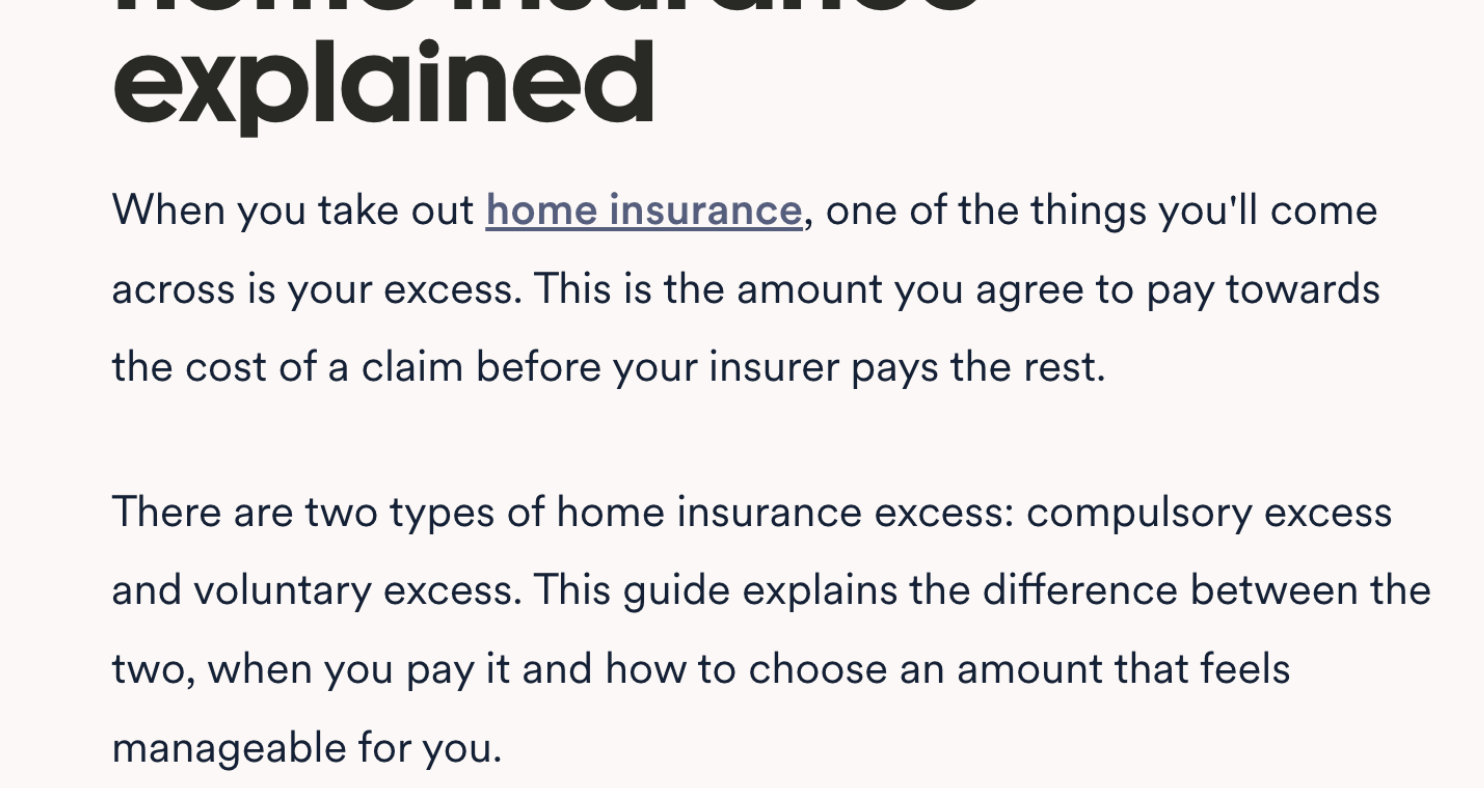
marshmallow.com · blog · home insurance excess explained
Informational content like this has a place in an SEO strategy, but only when it's driving link equity to a commercial page that's actually optimised. Right now, it's linking to a page with the wrong heading.
Well, it was up until a few months ago, they seem to have turned a corner a little. There's some effort at internal linking blog content together and internal linking to core revenue pages, though the anchor text choice isn't great.
A lot of insurance companies go wrong here, blogging for the sake of it. Traffic is hopeful, most aren't thinking about how to rein in traffic.
Let's be honest, no one comes to an insurance site to read their blog. The reason we cover question-based topics is to bring traffic in from search, some brand awareness but mainly to funnel users and push link equity to product pages.
As far as Marshmallow goes, I'm not a fan of every single page linking from the first line or even first paragraph to the main commercial page. The same anchor is used on every single post, repeatedly, no variation in anchor text. Google will likely start to discount this after reusing it so much, it doesn't look or sound natural, shoving an internal link in the opening line or paragraph of every page.
Fix the product page first
H1, meta title, slug, content, all aligned to the target keyword. Until the page tells Google what it is, links pointing to it are wasted.
Then link from high-authority pages
Homepage first. It's the most powerful page on the domain. Use keyword-rich anchor text: 'van insurance', 'home insurance', not generic phrases like 'find out more'.
Then build supporting content that earns links naturally
Informational blog posts bring in traffic and funnel equity to commercial pages. But vary the anchor text across posts. The same anchor on every page looks unnatural and Google will start to discount it.
What a Good SEO Would Do:
The Fix List.
None of this is complex. There is no secret tactic here. What Marshmallow needs is basic SEO, executed properly, across every product page. Here is the priority list.
Align slug, meta title, and H1 on every product page
All three must point at the same keyword. Start with the car insurance for expats page. Rewrite the meta title to lead with the primary keyword, not the brand, not 'award-winning,' not any modifier. Do this across every product page.
Fix the H1 headings: brand and SEO can coexist
You do not have to choose between brand and rankings. Use a dropped, smaller H1 with the keyword and a larger branded display heading for the visual. Every major comparison site does this. Google reads the H1 tag, not the biggest text on the page.
Build semantically complete headings and page copy
Use an on-page tool against the actual SERP competitors. Build out the H2 structure and page copy to cover the terms Google associates with the topic. Every product page needs this treatment: van insurance, car insurance, home insurance, expat car insurance.
Fix internal linking: homepage first
Link to core product lines from the homepage using exact keyword anchor text. Stop repeating the same anchor text in the opening paragraph of every blog post. Vary anchors, place links contextually, and only link once product pages are properly optimised.
Improve blog content depth and topical coverage
Informational content serves a purpose: building topical authority and funnelling link equity to commercial pages. That only works if the blog content is genuinely optimised. Right now it is not. Improve it alongside the product pages, not instead of them.
Start link building once the foundations are fixed
Digital PR to the homepage to reinforce brand and PageRank authority. The goal is not just breaking page one for commercial terms, it is sitting inside the top three. DR 56 gives Marshmallow a head start. Use it.
The Opportunity
Is Sitting There.
Marshmallow has something rare: a genuinely strong brand, a clear audience, and a domain Google already trusts. The raw materials for great SEO are all in place. What is missing is the on-page execution to turn that potential into traffic.
The fixes outlined here are not advanced SEO. They are fundamentals. Align your pages to what people are searching for. Name the product you are selling. Give Google the clarity it needs to do its job.
Done properly across every product page, the compounding effect on non-branded organic traffic would add a lot of recurring revenue.
The work is straightforward. The opportunity is not small.
For context on the brand side: Marshmallow worked with Ragged Edge on their visual identity, and the result speaks for itself. That is exactly what working with a top branding agency at the start-up stage can produce. The visual foundation is exceptional. The SEO now needs to match it.
Written by
Tom Riley
Founder of HAKKEN, a UK search consultancy specialising in search-led growth for growth-stage brands.